I am interested in models that do not just perceive the world but act in it.
Before that, my research was in 3D computer vision and neural rendering.
I hold a Ph.D. in Computer Science, which I earned at Skoltech within
Evgeny Burnaev's
Applied AI Center.
I received a Master's Degree in Data Science from Skoltech in 2020. Prior to that, I received
my Bachelor's in Applied Mathematics and Physics from the
Moscow Institute of
Physics and Technology (MIPT) in 2018.
Ramil Khafizov, Ilya Statsenko, Ruslan Rakhimov,
Artem Komarichev, Peter Wonka, Evgeny Burnaev
We generate novel views of an object by next-scale
autoregression over discrete tokens, anchored to camera geometry by a multi-scale
projective pose encoding. The model outperforms diffusion baselines in PSNR, SSIM and
LPIPS while running more than 3× faster.
Ruslan Rakhimov, George Bredis, Yuriy Maksyuta,
Daniil Gavrilov
We train a single JEPA world model whose objective pairs a
Brownian-bridge interpolant on the state axis with flow matching on the action axis, so
one checkpoint serves latent planning, behaviour-cloning action sampling and inverse
dynamics without retraining.
Yuriy Maksyuta, George Bredis, Ruslan Rakhimov,
Daniil Gavrilov
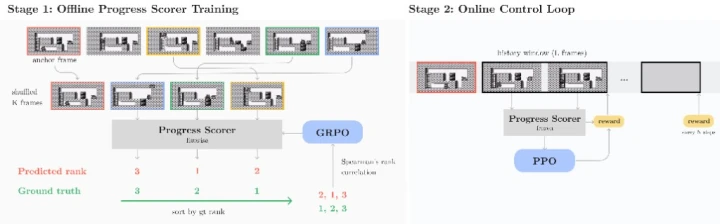
We train a VLM to rank shuffled frames by task progress, then
reward a policy by the rank correlation between predicted progress and real time — a
bounded, scale-free signal that needs no environment reward and transfers across tasks.
George Bredis, Nikita Balagansky, Daniil Gavrilov,
Ruslan Rakhimov
A decoder-free model-based RL agent that predicts next-step
encoder embeddings from latent state sequences, matching or exceeding DreamerV3 on the
DeepMind Control Suite and improving substantially on DMLab memory and spatial reasoning
tasks.
George Bredis, Stanislav Dereka, Viacheslav Sinii,
Ruslan Rakhimov, Daniil Gavrilov
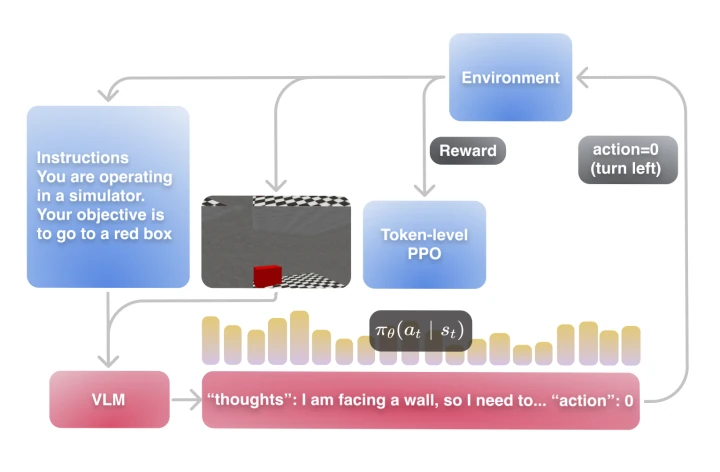
A lightweight RL recipe for vision-language agents that applies
PPO at the token level for actions while learning a step-level value function. Training
in one cheap synthetic environment produces policies that transfer beyond the training
simulator.
Gennady Sidorov, Malik Mohrat, Denis Gridusov,
Ruslan Rakhimov, Sergey Kolyubin
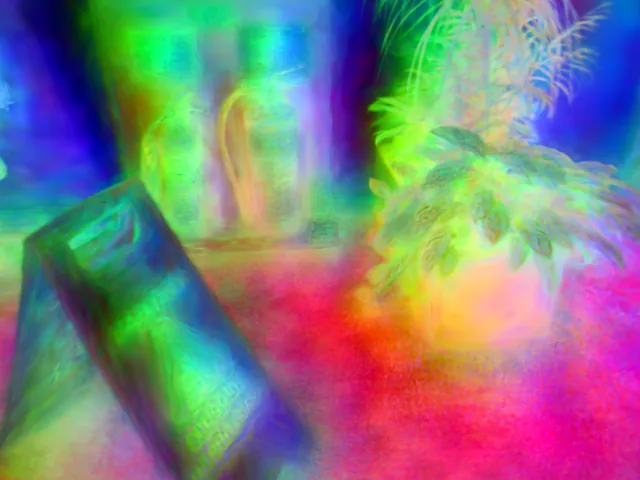
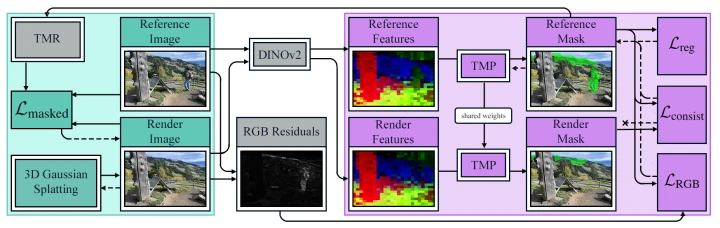
We present a novel approach that integrates dense keypoint
descriptors into 3D Gaussian Splatting to enhance visual localization, achieving
state-of-the-art performance on popular indoor and outdoor benchmarks.
Alexander Markin, Vadim Pryadilshchikov, Artem Komarichev,
Ruslan Rakhimov, Peter Wonka, Evgeny Burnaev
We propose a novel framework that leverages 3D Gaussian
Splatting to effectively remove transient objects from input videos, enabling accurate
and stable 3D scene reconstruction.
Oleg Voynov, Gleb Bobrovskikh, Pavel Karpyshev, Saveliy Galochkin,
Andrei-Timotei Ardelean, Arseniy Bozhenko, Ekaterina Karmanova, Pavel Kopanev,
Yaroslav Labutin-Rymsho, Ruslan Rakhimov, Aleksandr Safin, Valerii
Serpiva, Alexey Artemov, Evgeny Burnaev, Dzmitry Tsetserukou, Denis Zorin
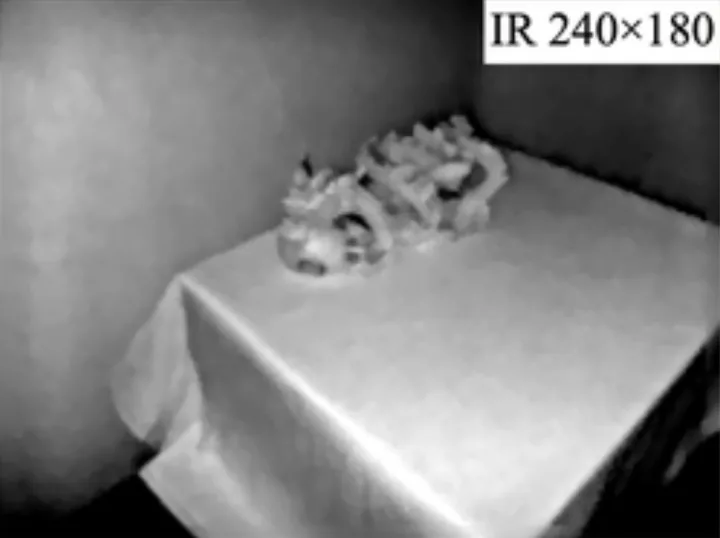
A new multi-sensor dataset for 3D surface reconstruction that
includes registered RGB and depth data from sensors of different resolutions and
modalities under a large number of lighting conditions.
Albert Matveev, Ruslan Rakhimov, Alexey Artemov,
Gleb Bobrovskikh, Vage Egiazarian, Emil Bogomolov, Daniele Panozzo, Denis Zorin, Evgeny
Burnaev
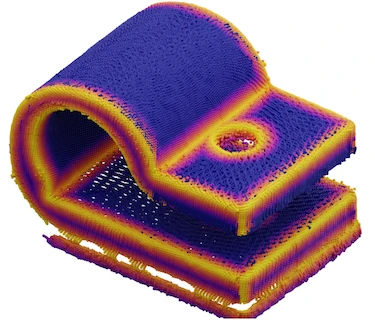
Differently from existing data-driven methods for predicting
sharp geometric features in sampled 3D shapes, which reduce this problem to feature
classification, we propose to regress a scalar field representing the distance from
point samples to the closest feature line on local patches.
Ruslan Rakhimov, Emil Bogomolov, Alexandr
Notchenko, Fung Mao, Alexey Artemov, Denis Zorin, Evgeny Burnaev
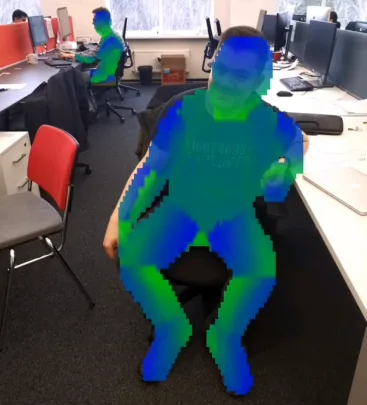
We target the problem of redesigning the DensePose R-CNN model's
architecture so that the final network retains most of its accuracy but becomes more
light-weight and fast.